
From 1 January 2027, new monobloc heat pumps up to 50 kW and new split air-to-water heat pumps up to 12 kW can no longer be placed on the EU market if their refrigerant has a global warming potential (GWP) of 150 or more. R32 is above that limit; R290 (propane) is not. Heat pumps already running on R32 are not affected: they can still be used, serviced and repaired.
This article explains what the EU F-gas Regulation (EU) 2024/573 actually requires, how R32 and R290 differ, which restrictions follow after 2027, and what to consider if you are planning a heat pump for a home in 2026 or 2027.
Key points
- From 1 January 2027, new monobloc heat pumps up to 50 kW and split air-to-water heat pumps up to 12 kW using F-gases with a GWP of 150 or more may not be placed on the market, unless this is required to meet safety requirements at the site.
- R32 (GWP 675) is caught by these rules; R290 (GWP 0.02) is not.
- The rules apply to placing new equipment on the market, not to using equipment that is already installed. A working R32 heat pump does not have to be replaced.
- R32 heat pumps can still be serviced and topped up with refrigerant: the servicing ban only covers F-gases with a GWP of 2,500 or more.
- Spare parts for repairing existing equipment remain allowed, as long as the repair does not increase capacity or the refrigerant charge, or switch to a higher-GWP refrigerant.
- R290 is not automatically the better choice. The right unit depends on the building’s heat demand, the heating system, where the outdoor unit can go and the specific model.
What are R32 and R290?
The refrigerant circulates inside the heat pump: as it evaporates it absorbs heat from the outdoor air, and as it condenses it releases that heat to the heating system. The refrigerant affects how the unit is designed, which safety requirements apply and how EU law treats it.
R32 is difluoromethane, a hydrofluorocarbon (HFC). It is an F-gas, so the F-gas Regulation applies to it. The European Commission lists R32 as one of the replacements for R410A in split systems.
R290 is propane, a natural hydrocarbon. It is not an F-gas, so the regulation’s GWP limits do not apply to it. Propane is, however, highly flammable, so equipment using it comes with its own safety and installation requirements.
What GWP and safety class mean
GWP shows how much more a substance contributes to global warming over 100 years than the same amount of carbon dioxide. Annex I of the regulation gives R32 a GWP of 675; Annex VI gives propane 0.02. You may see slightly different figures elsewhere because they are calculated from different IPCC assessment reports. For the legal limits, the values in the regulation are the ones that count.
The safety class describes toxicity and flammability. Both refrigerants are in the lower-toxicity group A. R32 is class A2L (lower flammability), R290 is class A3 (higher flammability). In other words, both come with safety requirements; for propane they are stricter.
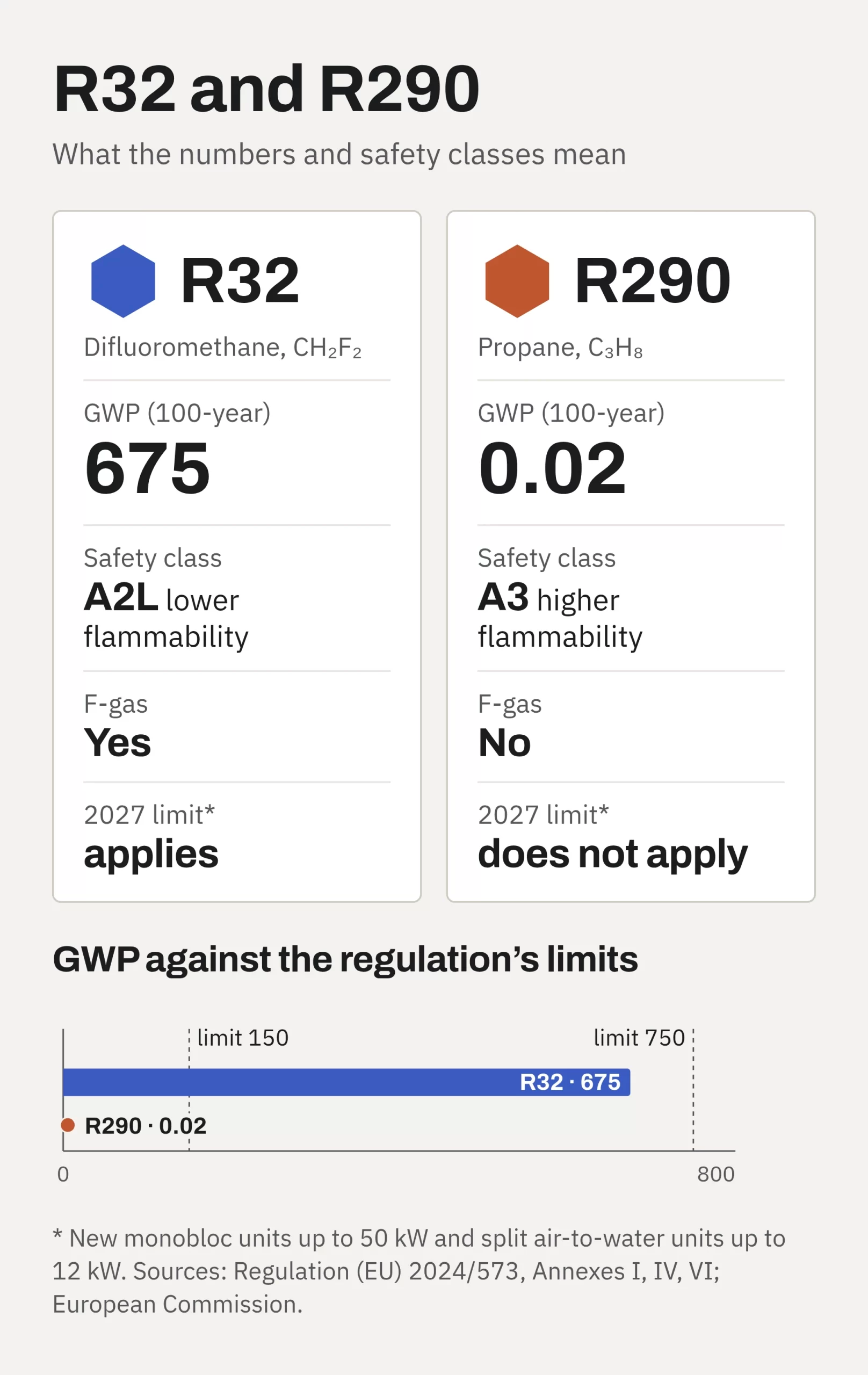
| R32 | R290 | |
|---|---|---|
| Substance | difluoromethane | propane |
| Formula | CH₂F₂ | C₃H₈ |
| F-gas | Yes (HFC) | No |
| GWP (100-year) | 675 | 0.02 |
| Safety class | A2L, lower flammability | A3, higher flammability |
| 2027 restriction* | Applies | Does not apply |
Monobloc, split air-to-water and split air-to-air: what is the difference?
The dates depend not only on the refrigerant but also on the type of unit. The regulation distinguishes between self-contained equipment and split systems.
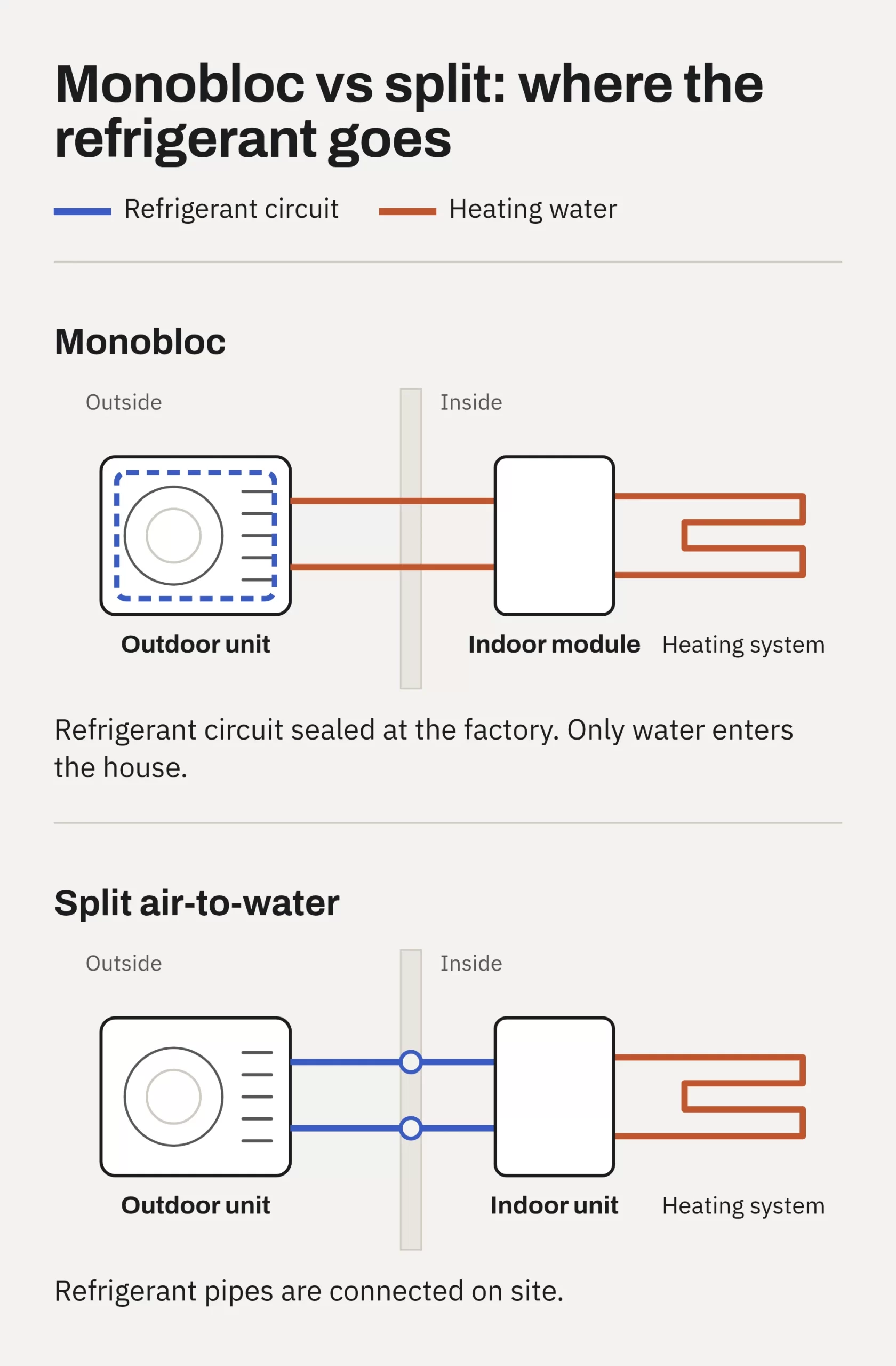
- Monobloc. The whole refrigerant circuit is built into the outdoor unit at the factory. Only the heating water pipes enter the house, and no refrigerant connections are made on site. The regulation calls this self-contained equipment.
- Split air-to-water. The outdoor and indoor units are linked by refrigerant pipes that the installer connects on site. The indoor unit transfers the heat to water for underfloor heating, radiators or fan coil units, and for hot water.
- Split air-to-air. Units linked by refrigerant pipes heat or cool the room air directly – this is how a typical wall-mounted air conditioner works.
A monobloc with an indoor module or hot-water cylinder is still a monobloc as long as only water goes indoors. What matters is not the number of boxes but whether the refrigerant circuit is connected on site. We compare the two types in more detail in “Monobloc vs split heat pumps: which should you choose?”.
What changes on 1 January 2027
Annex IV of the regulation lists equipment that may not be placed on the market from the dates shown. For heat pumps, two entries apply from 2027:
- Monobloc and other self-contained heat pumps up to 50 kW (point 8(b) and (d)) containing F-gases with a GWP of 150 or more.
- Split air-to-water systems with a rated capacity up to and including 12 kW (point 9(b)) containing F-gases with a GWP of 150 or more.
Put simply, from 2027 new R32 monobloc units up to 50 kW and new R32 split air-to-water heat pumps up to 12 kW can no longer be placed on the market. For split air-to-water systems above 12 kW, R32 remains allowed until 2033 (see below).
How rated capacity is determined is set out in Commission Implementing Regulation (EU) 2024/2195: where equipment can have different functions, the rated capacity refers to its primary function, and where ecodesign legislation sets a calculation method, that method applies. So check the threshold against the manufacturer’s declared rated capacity for the specific model, and if a unit is close to 12 kW, raise the question with the supplier.
What “placing on the market” means
Placing on the market means supplying a unit to the EU market for the first time – for example, when a manufacturer or importer releases it for free circulation. Units lawfully placed on the market before 1 January 2027 can therefore still be sold afterwards. From one year after the ban date, anyone supplying them further needs evidence that they were placed on the market in time (Article 11(1)).
If such a unit is put into operation after the ban date, the operator – in a private home usually the owner – must be able to show that it was placed on the market before that date, and keep the documents for at least five years (Article 13(19) and (20)). If you buy a remaining R32 unit from stock in 2027, ask the supplier for written confirmation.
The safety exception
Both 2027 restrictions include an exception where it is required to meet safety requirements at the site of operation. For monobloc units, the regulation adds that if safety requirements do not allow a refrigerant with a GWP below 150, a limit of 750 applies. This covers specific situations; it is not a general option to choose R32. The operator has to hold evidence that safety requirements at the location rule out lower-GWP equipment, so the exception should only be relied on when it is clearly justified and documented.
Later restrictions: 2029 to 2035
After 2027, the restrictions widen in stages. Below are the Annex IV dates relevant to heating and cooling. All of them concern placing new equipment on the market only.
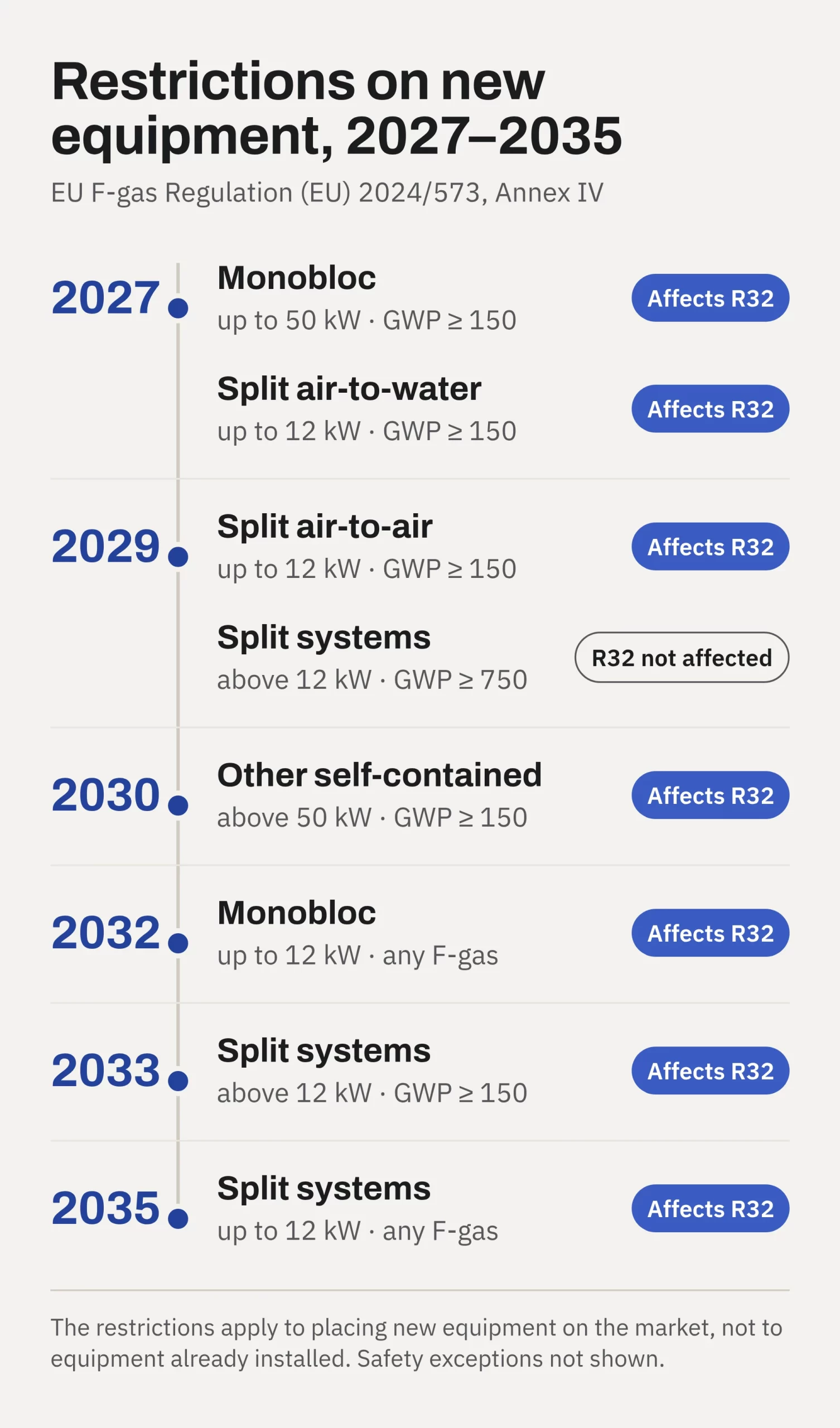
| From | Equipment and limit | Affects R32? |
|---|---|---|
| 1 Jan 2027 | Monobloc and other self-contained units up to 50 kW; GWP ≥ 150 | Yes |
| 1 Jan 2027 | Split air-to-water up to 12 kW; GWP ≥ 150 | Yes |
| 1 Jan 2029 | Split air-to-air up to 12 kW; GWP ≥ 150 | Yes |
| 1 Jan 2029 | Split systems above 12 kW; GWP ≥ 750 | No (R32 GWP 675) |
| 1 Jan 2030 | Other self-contained equipment (above 50 kW); GWP ≥ 150 | Yes |
| 1 Jan 2032 | Monobloc and other self-contained units up to 12 kW; any F-gas | Yes |
| 1 Jan 2033 | Split systems above 12 kW; GWP ≥ 150 | Yes |
| 1 Jan 2035 | Split systems up to 12 kW; any F-gas | Yes |
The regulation requires the European Commission to assess by 2030 whether suitable alternatives exist for bans that are not yet in force, particularly for split air conditioners and heat pumps (Article 35). The later dates could therefore be reviewed, but for now they are the ones that apply.
Will an installed R32 heat pump become illegal?
No. The Annex IV bans apply to placing new equipment on the market. The regulation does not require lawfully bought and installed R32 heat pumps to be removed or replaced, so they can run for their full working life.
If your R32 heat pump is working well, the 2027 changes alone are no reason to replace it. Base that decision on the unit’s condition, the cost of repairs and whether it still meets the needs of the house.
Servicing, refrigerant and spare parts
Topping up and repairs
From 2026, Article 13 prohibits using F-gases with a GWP of 2,500 or more to service air-conditioning equipment and heat pumps. R32 has a GWP of 675, so this ban does not apply: R32 heat pumps can be serviced, repaired and topped up with refrigerant when needed.
Only certified technicians may work on the refrigerant circuit, and only they – or companies employing them – may buy F-gases for this work (Articles 10 and 11). Whether your unit needs periodic leak checks depends on its refrigerant charge expressed in CO₂ equivalent (Article 5). The unit’s label or your installer can tell you.
Spare parts
The regulation still allows parts to be supplied for repairing existing equipment after the ban dates, as long as the repair does not increase the unit’s capacity or F-gas charge, or switch to a higher-GWP refrigerant (Article 11(1)). Spare parts do not become illegal. How long a particular manufacturer keeps making them is up to that manufacturer, so it is worth asking before you buy.
Will R32 get more expensive?
R32 itself is not banned, but the total quantity of HFCs that may be placed on the EU market is cut through quotas: in 2027–2029 it is roughly half the 2025–2026 level, and from 2050 it is zero (Annex VII). How this will affect the price and availability of R32 in Lithuania cannot be predicted with certainty – that is a market forecast, not a legal rule.
Is R290 always the better choice?
Not always. R290’s advantage is its very low GWP: the F-gas Regulation’s market restrictions do not apply to it, so the Annex IV dates are not a concern for an R290 unit. But the refrigerant is not everything:
- Efficiency depends on the model – the compressor, heat exchangers, controls and how well the unit is sized for the building. Compare the manufacturers’ seasonal performance figures at the same flow temperatures.
- Flow temperature. According to manufacturers’ data, some R290 models can deliver higher water temperatures, which can matter in a house with radiators. Check the data for the specific model rather than the refrigerant’s general reputation.
R290 is a forward-looking choice for a new monobloc, but it needs room for the safety zone, and the decision should rest on the building’s needs and the specific model’s data.
R290 safety and installation
Propane is heavier than air. If the circuit leaks, escaping refrigerant can collect near the ground and form a flammable mixture with air. That is why manufacturers define a safety zone around the outdoor unit.
For example, one manufacturer’s monobloc installation manual states that the protective zone must not contain windows, doors, light shafts, basement entrances or ventilation openings, or ignition sources such as sockets, switches and lights, and that the zone must not extend to neighbouring buildings or public traffic areas. The size and rules of the zone depend on the model and the type of installation – on the ground, on a wall or on a flat roof – so check them in the manual for the specific unit before choosing the location.
- A monobloc suits propane well: the refrigerant circuit stays in the outdoor unit and only water enters the house.
- Work on the refrigerant circuit must be done by qualified technicians. The regulation provides for certification and training to cover alternative refrigerants, including natural ones, where relevant (Article 10).
- Do not change the refrigerant in an existing unit: an R32 unit cannot safely be filled with propane, because the unit and its safety design are built for a specific refrigerant.
- Do not later add openings, basement steps or electrical fittings inside the safety zone that would break the manufacturer’s requirements.
How to choose a heat pump for a home in Lithuania
The refrigerant is only one criterion. What matters far more is that the unit fits the specific building:
- Heat loss. The output is sized for how much heat the building loses in the coldest weather, which depends on floor area, insulation, windows and airtightness. A unit that is too large or too small performs worse.
- Flow temperature and heating system. Underfloor heating usually runs at a lower temperature than radiators, and the lower the flow temperature, the easier it is for a heat pump to work efficiently. We lay underfloor heating pipes together with the plumbing work.
- Hot water. Cylinder size and how hot water is produced depend on the size of the household and how it uses water.
- Cold-weather performance. For Lithuanian winters, what matters is the output and efficiency the unit achieves at low outdoor temperatures, as stated in the manufacturer’s technical data.
- Noise. Compare sound power levels and consider the distance to bedroom windows and the neighbours.
- Space. The outdoor unit needs room, free airflow, condensate drainage and access for servicing – and, for R290, the safety zone.
- Electricity. A heat pump needs suitable power and control circuits, which are best planned together with the electrical work.
- Servicing. Consider who will service the unit and how, and how readily spare parts and manufacturer support are available.
IMAX LAB installs and services heat pumps with an output of up to 16 kW in Vilnius County, works with equipment from a range of manufacturers and helps choose it to suit the building and the budget. Because we also install units above 12 kW, it is worth knowing that different dates apply to split air-to-water systems up to 12 kW and above 12 kW. Find out more about our heating and cooling solutions.
Checklist for buying a heat pump in 2026–2027
- Ask for an assessment of the heat demand and an explanation of why that output was chosen.
- Find out whether the unit offered is a monobloc or a split system, and its rated capacity according to the manufacturer.
- Check which refrigerant it uses and how much. This is shown on the unit’s label and in the technical data.
- If you are offered an R32 monobloc or an R32 split air-to-water unit up to 12 kW in 2027 or later, ask for written confirmation that it was placed on the market before 1 January 2027, and keep it.
- For an R290 unit, check that the manufacturer’s safety zone fits at the planned location.
- Compare seasonal performance at the same flow temperatures, cold-weather output, noise and hot-water production.
- Check the warranty terms and the servicing the manufacturer requires.
Questions to ask your heat pump installer
- How did you calculate my home’s heat demand, and what flow temperature are you planning for?
- Why are you recommending this refrigerant and this type of unit?
- Do the 2027 restrictions apply to this unit, and what documents will I receive?
- Where will the outdoor unit go, and what safety zone or clearances does the manufacturer require?
- Do your technicians hold the certificates needed to work with this type of refrigerant?
- Who will service the unit, how often, and will spare parts be available?
- Does this unit need periodic leak checks?
Frequently asked questions
Are all R32 heat pumps banned in the EU from 2027?
No. From 1 January 2027, new R32 monobloc units up to 50 kW and new R32 split air-to-water heat pumps up to 12 kW may not be placed on the market, subject to safety exceptions. For split air-to-air units up to 12 kW the restriction applies from 2029, and for split systems above 12 kW from 2033. Units already installed are not affected.
Do I have to replace my existing R32 heat pump?
No. The regulation does not require lawfully installed equipment to be replaced. It can be used, serviced and repaired for its whole working life.
Can an R32 heat pump still be topped up with refrigerant?
Yes. The servicing ban only covers F-gases with a GWP of 2,500 or more, and R32 has a GWP of 675. The work must be done by a certified technician.
Will spare parts for R32 heat pumps still be available?
Yes. The regulation allows parts to be supplied for repairing existing equipment, as long as the repair does not increase capacity or the refrigerant charge, or switch to a higher-GWP refrigerant. How long a particular manufacturer makes parts is up to that manufacturer.
Is R290 safe?
R290 units are designed to meet the safety requirements for flammable refrigerants. Whether an installation is safe depends on the unit being installed according to the manufacturer’s instructions, the safety zone being respected and the work being done by qualified technicians.
Which refrigerant should I choose for a new home?
From 2027, new monobloc units and split air-to-water units up to 12 kW can no longer be placed on the market with R32, so they use lower-GWP refrigerants such as R290. But the unit should be chosen first for the home’s heat demand, the heating system and where the outdoor unit can go; the refrigerant is one of those factors.
Can any heat pump use R290?
No. The manufacturer chooses the refrigerant when designing the unit, so R290 is only used in units built for it. And not every site has room for the manufacturer’s safety zone – for example, where the only place for the outdoor unit is next to windows or an entrance.
Summary
The 2027 changes affect which new heat pumps can be placed on the market, not the status of units already installed. R32 owners have no reason to worry: their units can be used, serviced and repaired. If you are planning a new system, the refrigerant matters less than correctly sized output, the right heating system, a suitable location and good installation.
Planning a new heating system? Send us the house design or floor plan – we will help you assess which heat pump suits your building, propose a system design and prepare a preliminary estimate. Read more about heat pump selection and installation or send us an enquiry.
Sources
- Regulation (EU) 2024/573 on fluorinated greenhouse gases – Articles 3, 5, 10, 11, 13 and 35; Annexes I, IV, VI and VII.
- Corrigendum to Regulation (EU) 2024/573 (24 March 2025) – Article 13(19).
- European Commission, “Air conditioning” – refrigerant GWP values and safety classes, overview of the restrictions.
- European Commission, “F-gas legislation” – list of amendments and implementing acts.
- Vaillant, aroTHERM plus VWL 35/6–75/6 installation and maintenance instructions (0020330791_03), section 4.1 – example of a protective zone.
The legislation and any amendments were last checked on 22 October 2026. This article is for general information and is not legal advice.