
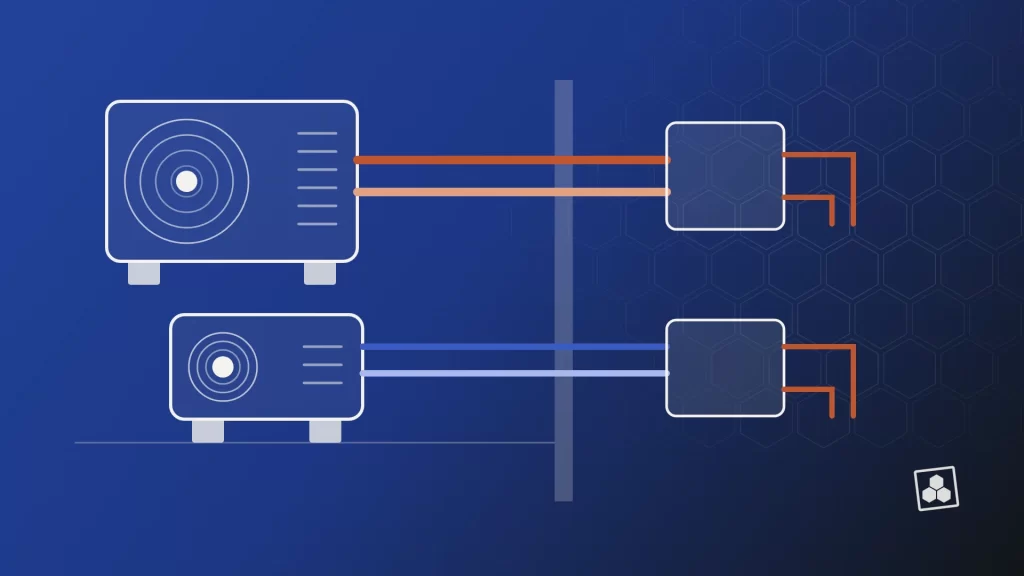
With 2027 approaching, you often hear that “from 2027 only monobloc heat pumps will be allowed”. That is not true. The EU rules restrict refrigerants by their global warming potential (GWP), equipment category and capacity – not the type of heat pump. Both monobloc and split air-to-water heat pumps will still be placed on the market as long as they meet the requirements.
This article explains the practical differences: where the refrigerant circuit is, what runs through the wall, how to deal with the risk of freezing in a Lithuanian winter, how installation differs and what to discuss with your installer.
Short answer: which is better?
- Neither is better across the board. Both can be the right choice – it depends on the layout of the house, where the outdoor unit can go, the distance to the plant room and the specific model.
- Monobloc: the whole refrigerant circuit sits in the outdoor unit and heating water runs into the house. No refrigerant connections are made on site, but the water outside needs manufacturer-approved freeze protection.
- Split: refrigerant pipes connect the outdoor and indoor units, and the water stays inside the building. The refrigerant connections must be made by a certified technician.
- Efficiency depends on the model, not on whether the unit is a monobloc or a split.
- From 2027, the refrigerants allowed in new equipment change, but neither type is banned. More in our article “R32 vs R290 heat pumps: what changes under EU rules in 2027?”.
What is a monobloc heat pump?
In a monobloc, the whole refrigerant circuit – compressor, heat exchangers and refrigerant lines – is assembled and charged at the factory inside one outdoor unit. The outdoor unit heats water, which flows through pipes into the building and back. Inside there is usually an indoor module with the controller, a circulation pump or a hot-water cylinder; what exactly depends on the model.
The EU F-gas Regulation calls this self-contained equipment: a factory-made system whose refrigerant-containing parts are not connected on site. The number of boxes is not what counts. Some manufacturers offer two-part systems (sometimes called “hydro split”) with only water between the units. If the refrigerant circuit is not connected on site, it works on the monobloc principle.
Advantages and limitations
- Installation: the installer connects water pipes while the refrigerant circuit stays sealed. According to one manufacturer, no refrigerant certificate is needed to install a monobloc.
- Water outside: the outdoor pipes need good insulation and a freeze-protection plan.
- Distance: the longer the outdoor water run, the greater the heat loss, so the outdoor unit usually stands close to the plant room.
- R290 monoblocs: manufacturers define a safety zone around the outdoor unit that must be free of windows, doors, ventilation openings and ignition sources.
What is a split heat pump?
In a split air-to-water system the refrigerant circuit is divided: the outdoor unit usually holds the compressor and evaporator, and the indoor unit holds a heat exchanger where the refrigerant passes its heat to the heating water. The units are linked by refrigerant pipes that the installer connects on site. The heating water circulates only inside the building.
- Qualifications: only certified technicians may work on an F-gas refrigerant circuit, and equipment with F-gases that is not hermetically sealed may only be sold to an end user with evidence that a certified company will install it (Articles 10 and 11 of the Regulation).
- Distances: the manufacturer sets the maximum pipe length and height difference. For example, one manufacturer’s split system allows up to 40 m of pipe and a 30 m height difference – other models may differ.
- Flexibility: the outdoor unit can often stand further from the plant room, for example where its noise will disturb less.
- Servicing: tight refrigerant joints are the key measure of installation quality, and whether periodic leak checks are required depends on the refrigerant charge expressed in CO₂ equivalent.
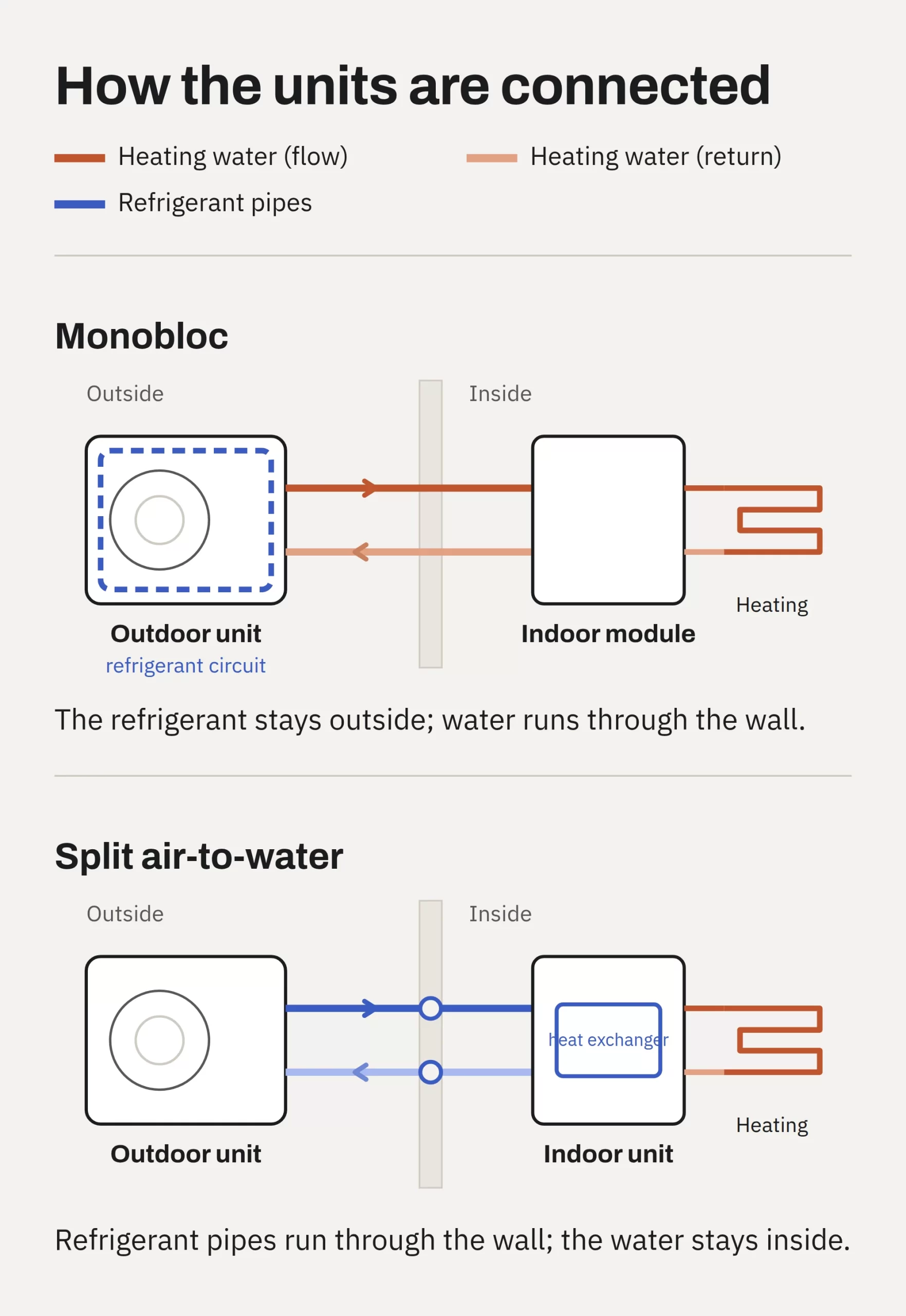
Monobloc vs split: the main differences
| Monobloc | Split air-to-water | |
|---|---|---|
| Refrigerant circuit | Outdoor unit, sealed at the factory | Both units, connected on site |
| Through the wall | Water pipes | Refrigerant pipes |
| Water outdoors | Yes – needs frost protection | Usually not |
| Installation | Water circuit and electrics | Refrigerant joints by a certified technician |
| Unit spacing | Limited by heat loss and the manual | Within the maker’s pipe length and height limits |
| New units from 2027 | GWP < 150 up to 50 kW | Up to 12 kW: GWP < 150; above: R32 until 2033 |
Installation and servicing: what to know
Either way you need space for the outdoor unit with free airflow, condensate drainage that will not freeze in winter, and easy access for servicing. Both types also need power and control cabling.
- Monobloc: the key points are the water run through the wall, its insulation and freeze protection. The wall openings are usually larger than for refrigerant lines.
- Split: the key point is a properly connected and tested refrigerant circuit. The indoor unit with the heat exchanger goes in the plant room.
- Heating system: in both cases heat reaches the rooms through underfloor heating, radiators or fan coil units. We lay underfloor heating pipes together with the plumbing work.
- Servicing: both types need the servicing the manufacturer specifies, and only qualified technicians may work on the refrigerant circuit.
Freezing risk in a Lithuanian winter
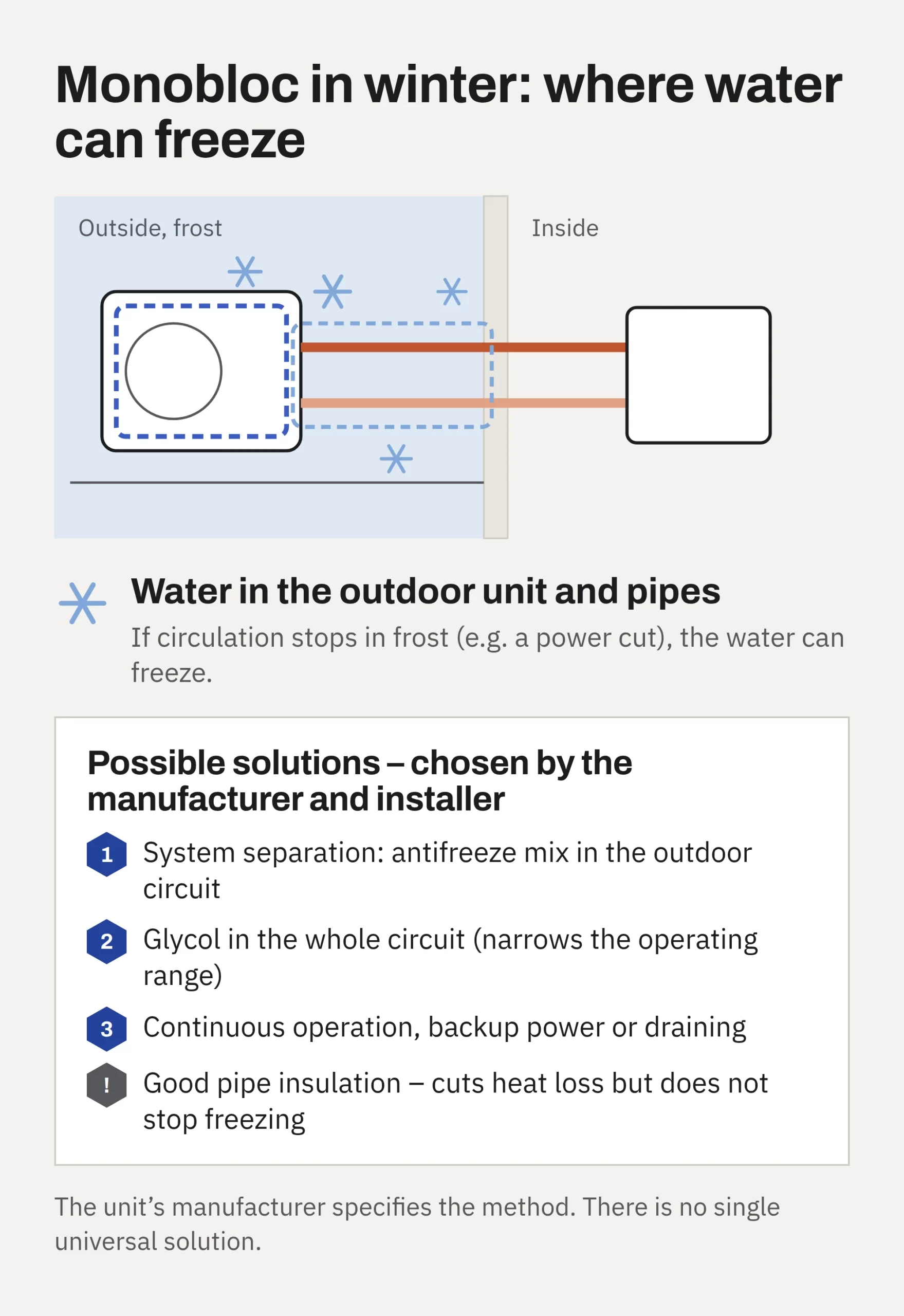
This is one of the most important practical differences. In a monobloc, water sits in the outdoor unit and the outdoor pipes. While the unit runs and the water circulates, it does not freeze. But if circulation stops in frost – during a power cut, a fault or when the unit is switched off – the water outside can freeze and damage the equipment.
That is why freeze protection for a monobloc has to be planned in advance. Manufacturers offer different solutions:
- System separation. An intermediate heat exchanger is fitted in the indoor module and the outdoor circuit is filled with a water and antifreeze mix. One manufacturer’s manual states that the outdoor unit is then protected even when switched off or during a power cut.
- Glycol in the whole circuit. Another manufacturer’s manual protects the water circuit with glycol, but notes that glycol lowers the unit’s permitted operating limits.
- Continuous operation or draining. Without system separation, manufacturers generally require the unit to keep running in frost, and if that cannot be guaranteed, a professional should drain the system. For longer power cuts, backup power or other manufacturer-approved safeguards can be considered.
- Insulation reduces heat loss but does not prevent freezing if circulation stops for long.
The manufacturer specifies the method and the installer chooses it for the route, location and reliability of the power supply. In a split system there is usually no heating water outdoors, so this risk does not arise – but it does not heat without power either, and the indoor water circuit must also be in a heated space.
Is a monobloc more efficient than a split?
Not in itself. Manufacturers point out that efficiency depends more on product quality, refrigerant properties, installation and servicing than on whether the unit is a monobloc or a split (Vaillant). When comparing models:
- compare seasonal efficiency (SCOP) at the same flow temperatures and climate conditions;
- check the output and efficiency the unit achieves at low outdoor temperatures;
- make sure the output suits the building’s heat demand and heating system;
- compare noise levels and consider where the outdoor unit will stand.
Nor can the price difference be generalised. Installation cost depends on the length of the run, wall openings, freeze protection, refrigerant work, the indoor equipment and adapting the existing heating system.
What changes in 2027?
From 1 January 2027, Annex IV of Regulation (EU) 2024/573 prohibits placing on the market:
- new monobloc and other self-contained heat pumps up to 50 kW containing F-gases with a GWP of 150 or more;
- new split air-to-water heat pumps up to 12 kW containing F-gases with a GWP of 150 or more.
For split air-to-water systems above 12 kW, R32 (GWP 675) remains allowed until 2033; for split air-to-air systems up to 12 kW the restriction applies from 2029. From 2032, monoblocs up to 12 kW, and from 2035, split systems up to 12 kW, may not contain any F-gases. All of these dates concern placing new equipment on the market: installed units do not have to be replaced.
Both 2027 restrictions include an exception where it is required to meet safety requirements at the site. According to the European Commission’s explanation reported by the European Heat Pump Association (EHPA), the exception is assessed for the specific location, and equipment using it must be labelled accordingly.
Will you still be able to buy a split heat pump after 2027?
Yes. The Regulation does not ban split systems – it restricts the refrigerants they use:
- split air-to-water units up to 12 kW can still be placed on the market with refrigerants whose GWP is below 150. These may be R290 or low-GWP A2L refrigerants such as R454C, which the European Commission lists among the alternatives for domestic heat pumps;
- split systems above 12 kW with R32 remain allowed until 2033;
- units lawfully placed on the market before 2027 can still be sold and installed later, with documents to prove it.
Which models will be available in Lithuania cannot be predicted. Some manufacturers say they are developing split systems with R290 and R454C (Daikin), but these are plans, not guarantees.
Which should you choose for a new or renovated home?
- Plant room on an outside wall, short run: a monobloc is often the simple option, provided freeze protection is planned and there is room for the outdoor unit (and, for R290, its safety zone).
- The outdoor unit needs to stand further away because of noise, neighbours or looks: a split system can offer more flexibility if the distance is within the manufacturer’s limits.
- No room for an R290 safety zone: consider another location or another system.
- Renovated house with radiators: what matters most is the water temperature needed in the coldest weather. That drives the choice of model more than the type of unit.
- New low-energy house: a small output is often enough, so for new equipment from 2027 the GWP < 150 limit will apply whichever type you choose.
IMAX LAB installs and services heat pumps with an output of up to 16 kW in Vilnius County, works with equipment from a range of manufacturers and helps choose it to suit the building and budget. Find out more about our heating and cooling solutions.
What to discuss with your installer before you decide
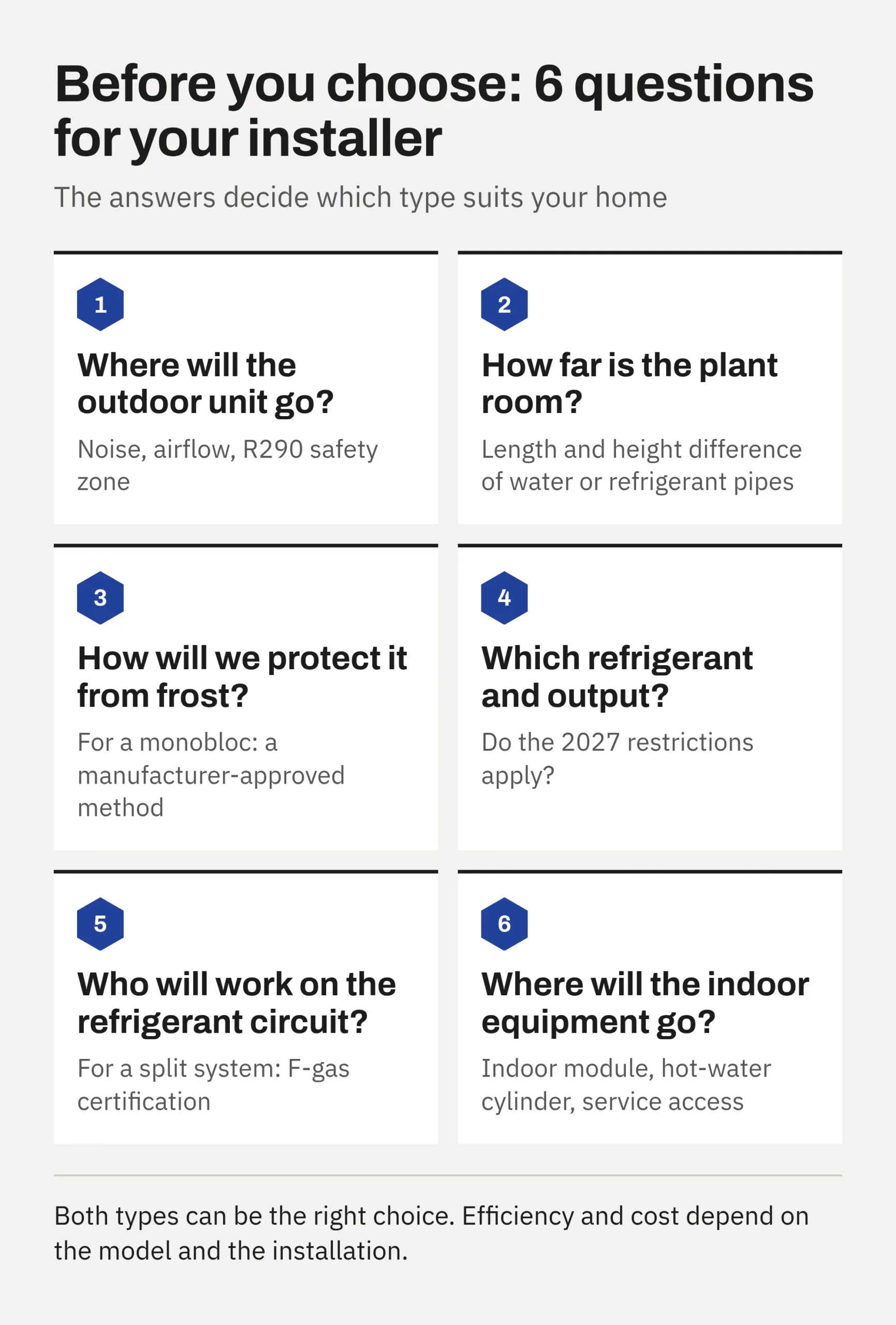
- Where will the outdoor unit stand, and does that spot meet the noise, airflow and (for R290) safety-zone requirements?
- How long will the water or refrigerant pipes be, and what height difference – are they within the manufacturer’s limits?
- How will a monobloc be protected from freezing during a power cut, and which method does the manufacturer allow?
- Which refrigerant and rated output – do the 2027 restrictions apply, and what documents will I receive?
- Who will work on the refrigerant circuit, and do the technicians hold the required certificates?
- Where will the indoor module or unit and the hot-water cylinder go, and will they be easy to service?
- What servicing does the manufacturer require, and what are the warranty terms?
Frequently asked questions
Will all split heat pumps be banned from 2027?
No. From 2027, refrigerants with a GWP of 150 or more are not allowed in new split air-to-water units up to 12 kW. Split systems with lower-GWP refrigerants, and split systems above 12 kW with R32 (until 2033), will still be placed on the market.
Can a monobloc heat pump freeze during a power cut?
It can, if the water outdoors stops circulating in frost for a long time and there is no protection. That is why you need a manufacturer-approved solution: system separation with antifreeze, glycol, backup power or other measures the manufacturer specifies.
Is a split heat pump better for Lithuanian winters?
There is no water in its outdoor part, so the freezing risk outside is lower. But output and efficiency in the cold depend on the specific model, not the type, so compare the manufacturers’ data.
Is R290 only used in monobloc heat pumps?
Not necessarily. R290 is currently common in monoblocs because their refrigerant circuit stays outside, but manufacturers are also developing split systems with R290 and other low-GWP refrigerants.
Which type is cheaper to install?
There is no universal answer. The cost depends on the length of the run, wall openings, freeze protection, refrigerant work, indoor equipment and the existing heating system, so compare specific quotes.
Does a monobloc need an indoor unit?
Usually yes: there is an indoor module with the controller, pump or hot-water cylinder. Which parts are needed depends on the model and the system.
Which heat pump should I choose for a new energy-efficient home?
Such a home usually has a low heat demand, so both types can work. Choose by where the outdoor unit can go, the distance to the plant room, hot-water needs and the specific model’s data – and, for new equipment from 2027, a low-GWP refrigerant.
Conclusion
The difference between a monobloc and a split comes down to what passes through the wall of the house: water or refrigerant. That drives the main differences – freeze protection, installation work, distances and installer qualifications. The 2027 rules change which refrigerants are allowed, but ban neither type. The best choice is the one that suits the particular house, site and heating system.
Planning a new heating system? Send us the house design or floor plan – we will help you assess which type and model of heat pump suits your building and prepare a preliminary estimate. Send us an enquiry.
Sources
- Regulation (EU) 2024/573 on fluorinated greenhouse gases – Articles 3, 5, 10, 11, 13 and Annex IV.
- European Commission, “Air conditioning” – refrigerant alternatives and overview of the restrictions.
- European Heat Pump Association, “The new F-gas Regulation: detailed guidelines” (November 2024) – safety exception, rated capacity.
- Vaillant, “Mono prieš split” (in Lithuanian) and aroTHERM plus installation manual (0020330791_03, sections 3.4 and 5.3).
- Daikin, “F-gas regulation: air-to-water heat pumps” and Altherma monobloc compact installer reference guide (4P598847-1, 2019).
The legislation and sources were last checked on 22 October 2026. This article is for general information and is not legal advice.